
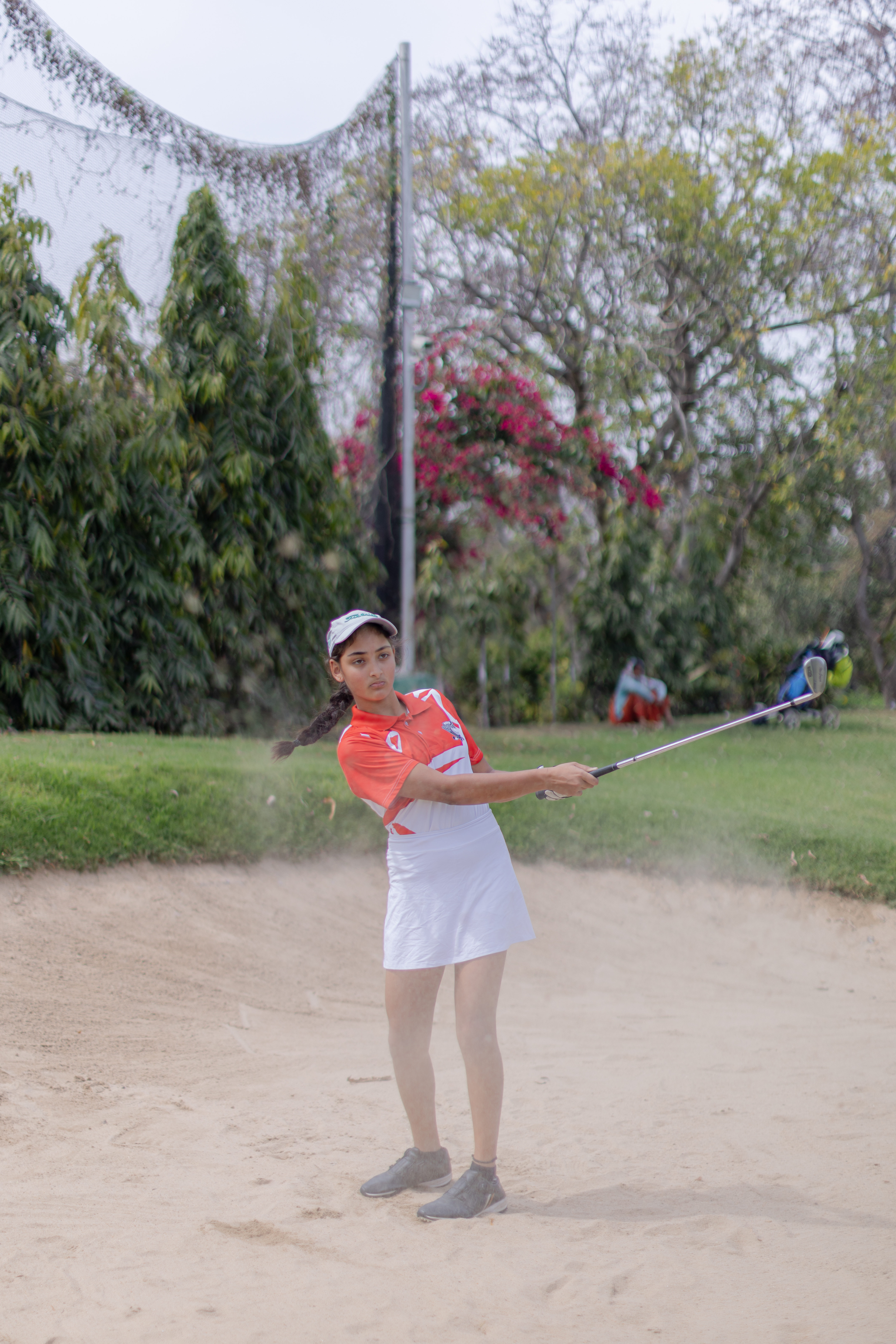
The morning of the first round at the Black Mountain Asian Junior Masters in Hua Hin, Thailand, I looked around the tee box and counted the flags on the bags.
China. Japan. South Korea. Thailand. Philippines.
And me — from Jaipur, Rajasthan. The only Indian.
I remember thinking: nobody here knows my name. Nobody has seen me at Rambagh Golf Club or read about me in Rajasthan Patrika. Out here, I'm not ranked No. 1 in India. Out here, I'm just the girl from the subcontinent who showed up with a Callaway bag and a 5 AM wake-up habit.
That feeling lasted exactly until I hit my first drive.
Round 1: Learning the Course, Trusting the Process
Black Mountain is one of the most technically demanding golf courses in Asia. Wide fairways that punish you if you get comfortable with them. Greens that slope in directions you don't expect. Heat that climbs to 35°C by the back nine and starts playing tricks with your club selection.
I shot +2 in Round 1. Tied 4th on the leaderboard.
My coach, Jessi Sir (Jesse Grewal — Dronacharya Awardee), always says: in unfamiliar conditions, your first round is your research round. You're not playing for birdies yet. You're learning the course. I kept that in my head on every hole. When a putt broke differently than I read it, I filed it away instead of getting frustrated. When an approach flew longer in the Thai humidity, I adjusted my calculations for the next time.
T4th after Round 1. Still in it.
Round 2: Feeling Like I Belonged
Something shifts in Round 2 of an international tournament. The nerves of "am I good enough to be here" fade, and you start actually playing.
I shot +1. Moved up to 3rd on the leaderboard.
That was the round I remember most clearly. Not because the score was spectacular — it wasn't. But because for the first time, I stopped being aware of the flags on the other players' bags. I stopped translating every hole into "this is China's best, this is South Korea's best." I was just playing golf. My golf. The same golf I play in Jaipur at 5 AM when the fairways are still wet with dew.
3rd place. Against Asia's best junior girls.
Round 3: What Happens When It Gets Hard
I'd be dishonest if I made this a perfect story.
Round 3, I shot +5. The leaderboard moved, and I finished T5th overall.
I'm not going to pretend the third round was easy to process. After being in 3rd, T5th feels like a step backward when you're standing inside it. But here's what I've learned about hard rounds — and I've had plenty of them in 8 years of competitive golf: they're not failures. They're feedback.
The girls who finished ahead of me that day have been playing international circuits for longer. They've stood on courses in more countries. They've learned things about pressure management that only competition can teach, and they've had more reps doing it.
My third round told me exactly what I need to work on next.
That's not a loss. That's a curriculum.
What T5th at an Asian Junior Championship Actually Means
When I got home, a few people said "So close to the podium!" — as if T5th was a near miss that needed sympathy.
I don't see it that way.
Six countries. Asia's best junior girls. Three rounds on a championship course in a different country, in a different climate, against players who've been doing this for years. And I finished fifth.
At 14 years old. From Jaipur.
The point was never the trophy — or not only the trophy. The point was the room. When you put yourself in a room where everyone is better than you expect them to be, you grow at a rate that 10,000 hours of practice at home can't replicate. International competition compresses time. It shows you your gaps faster than anything else.
Hua Hin showed me mine. And now I know exactly what to fix.
The Bigger Picture — and Why It Matters for Indian Golf
Golf is a sport where very few Indian girls grow up seeing a path to the top. There's no Virat Kohli to idolize at age 7. There are no posters on bedroom walls. When I started at age 7 in 2018, I didn't have a blueprint for what an Indian girl in golf could look like.
I'm trying to become that blueprint.
Every time I compete at an international event — against players from countries where golf has decades more infrastructure, funding, and federation support — I'm doing something that data says is unlikely. A girl from a Tier-2 city in India, training 10+ hours a day, competing for podiums against Asia's best.
I believe by 2032 — Brisbane — that story ends with a flag on the 18th green.
Not because I'm certain. Because I'm building toward it, one international round at a time.
A Note to Every Parent Who Wonders If It's Worth It
If you're reading this and you have a child who plays golf — or wants to — and you're wondering whether the early mornings and the tournaments and the investment are worth it: I can't answer that for you.
But I can tell you what it's worth to me.
Standing on that tee box in Hua Hin, representing India, competing against the best in Asia — that moment cost years of 5 AM wake-ups and weekends I traded for practice sessions. And I would trade them again without a second thought.
Golf has given me the world. Literally. I intend to keep exploring it, one championship at a time.
Shiksha Jain is India's No. 1 junior girl golfer (IGU Category B) and a WAGR-ranked athlete from Jaipur, Rajasthan. She trains under Dronacharya Awardee coach Jesse Grewal and is on the road to LA 2028 and Brisbane 2032.
Follow her journey: @golfer_shiksha on Instagram · YouTube · LinkedIn